

I hated this book.
I hated its execution. Hated its arrogance. Hated, most of all, its squandered potential.
I didn’t want to hate this book.
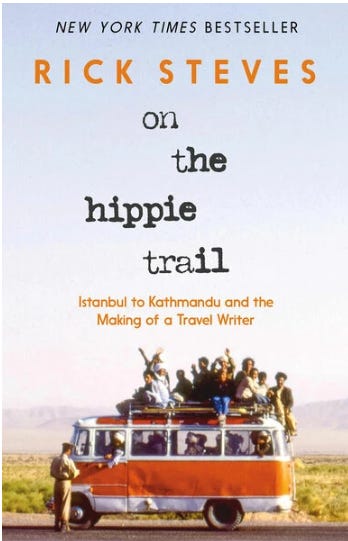
When I saw last year that Rick Steves was publishing On the Hippie Trail, Istanbul to Kathmandu and the Making of a Travel Writer, I was excited. At last, the most successful guidebook author-turned-TV-host of his generation—and, by all accounts, one of the most upright souls in the travel industry—was going to give readers a glimpse under the hood of his empire’s origin story. And as a budding travel writer, I was eager to learn about how he established his name and how he figured out how to sell books based on facts that are outdated the moment you ink them to paper. At the very least, I surmised, the book would give readers insights into the world of decades ago, peppered with insights from one who makes his living chronicling that world.
Silly me.
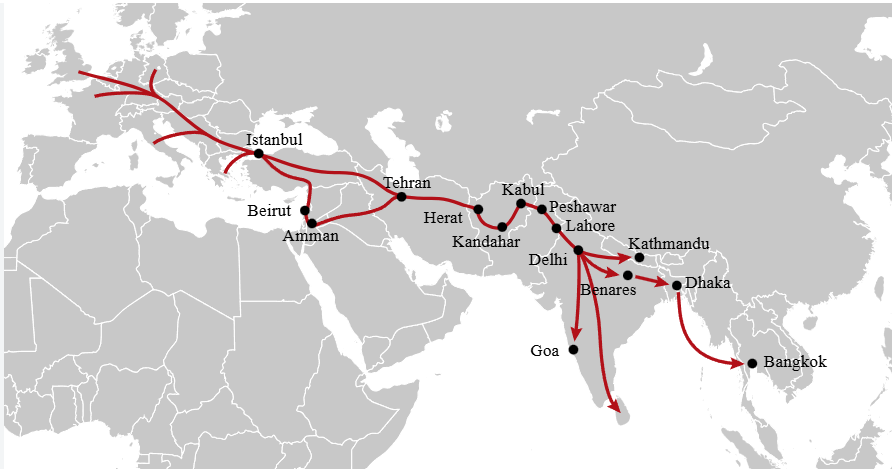
Some level-setting. On the Hippie Trail chronicles an overland trip that Rick and his friend (and frequent collaborator) Gene Openshaw took from Istanbul to Kathmandu in the summer of 1978. Rick not only visited, but kept a 60,000-word diary of Iran before the ayatollahs, Afghanistan without a whiff of Soviets or Taliban, Pakistan before it went nuclear, and India before it became the world’s economic engine. Such a chronicle had more potential for gold than Smaug’s hoard in Erebor. We got Nathan MacKinnon vs. the open net.
In 2008, Paul Theroux published Ghost Train to the Eastern Star, wherein he re-traced his own trip from the Seventies, chronicling both the changes in the world and in the author. By contrast, On the Hippie Trail barely acknowledges that these countries are unrecognizable from the ones Rick visited. It has zero insight into hints that Rick might have glimpsed at the time, but which only make sense in retrospect. Instead, I learned what an American boomer ate for breakfast in 1978. About long bus rides (ohmigod, it’s bumpy!) through Iran. About cheap hotels (wow, there are cockroaches!). About border hiccups that prove little more than inconveniences.
On the Hippie Trail fails on “the making of a travel writer” as well. All we learn--in one sentence at the end--is that Rick decided to stop giving piano lessons and start a travel business. That’s it. We learn none of how this business grew, or how Rick balances writing with the drudgeries of making payroll. We don’t learn why Rick decided to focus his work on Europe, on beaten-track cities and high-end hotels, which don’t feature in this book at all. All we are left to assume is that “I took a trip. I enjoyed it so much I decided to make my livelihood out of something kind of related.” Features on Rick in The Washington Post and the New York Times offer far richer insight into this part of his life. I wish the man himself had been more candid.
If there’s one redeeming quality about On the Hippie Trail, the photography is golden. The snaps, rendered on film, capture that bygone world in ways that the text falls short. (Perhaps it would have been better as a coffee table book to spare us the reading). Rick could have made a living as a travel photographer.
On the Hippie Trail doesn’t dent my respect for Rick. He is still an upstanding guy and has built a travel empire that many of us can only envy or doff our caps to. But all I know, dear reader, is that when I eventually turn my 2005-06 New Zealand diary into a bestseller, I will base it around how the world and I have changed in the decades since. On the Hippie Trail taught me the pitfalls of thinking the world would care because I’m famous.
In sum, this book wasn’t worth what I paid for it. I got it from the library.