

It’s coincidence, yes, but poetic still that Eva zu Beck launched her memoir The Wilder Way weeks before the world re-discovered the Odyssey. In the book, Ms. zu Beck details how her own odyssey through some of Earth’s remotest, least hospitable locales transformed her from directionless divorcee to YouTube and social media sensation. As a kicker, Ms. zu Beck does much of this in her ancient Land Rover, Odyssey.
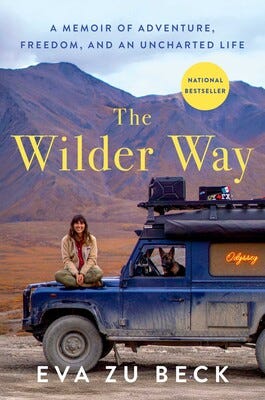
Her initial chapters didn’t leave me optimistic. Her prologue is almost beat for beat the same predicament--an equipment malfunction miles from anywhere--that opens Cheryl Strayed’s Wild. But whereas Wild slows down and unfurls the trauma and loss that drove Strayed onto the Pacific Crest Trail, The Wilder Way speeds through Ms. zu Beck’s early days, light on details and long on anecdotes. We learn that Ms. zu Beck’s marriage failed in part due to her infidelity, but only after the fact and through her husband’s non-reaction. We learn about her descent into alcohol, drugs, and thoughts of suicide, but gain little insight into Ms. zu Beck grappling with her despair. Whether this is due to Ms. zu Beck’s guilt, a rush to her meal ticket (the travels), or whether the details of that era are tied up in NDAs, we don’t know. But since Ms. zu Beck has already documented much of her road life on tape, I had hoped The Wilder Way would offer more about the anguish that drove her there. By the time Ms. zu Beck scrapes together enough for her one-way ticket to Nepal, some 40 pages in, I felt like I barely knew the character.
On the road, though, Ms. zu Beck shines. Her descriptions of waystations ranging from homes in Pakistan to trekking the Himalayas in Nepal to whiling out the early pandemic on Socotra Island in Yemen bring out vibrant, theatrical details reminiscent of her vlogs. (A 300-strong YouTube library must help with research.) And while some of her metaphors are cringeworthy--”they launched their questions at me like long-range missiles” -- it’s impossible not to appreciate Ms. zu Beck’s aptitude for translating visuals to text. The entire time, I could hear Ms. zu Beck’s dulcet British tone, pulsing with wonderment as it led me along. The Wilder Way would make an entertaining audiobook.
Yet most touching about The Wilder Way is how it evolves from a trauma-and-guilt memoir to one of finding a journey home--not home in the physical sense (though that happens), but in peace with herself. Ms. zu Beck confronts burnout more honestly than most memoirs I’ve read. While her travels beget epiphanies that, in lesser hands, could seem too perfect, Ms. zu Beck avoids the trap of making them seem forced. Plus, if someone spends all her time on the road, where else would she learn?
The thin beginning aside, my biggest critique of The Wilder Way lies with Ms. zu Beck’s editors. Those cringey metaphors notwithstanding, a bit more cleanup could have helped. To wit, consecutive paragraphs use the phrase “call mountains home.” And several scenes seem to come out of nowhere: Ms. zu Beck details her joy over leaving the Catholic Church, yet no antecedent indicates she had a problem with it. Lastly, a book that strives to bridge cultures should know that it’s the Afghan-- not Afghani-- border.
In interviews promoting The Wilder Way, Ms. zu Beck has speculated about dialing back her online life in favor of writing. She should. Now that she has settled into semi-nomadic life in the Carpathians, it would be interesting to see how her lifestyle evolves, or even if it remains sustainable, as approaches middle age. Regardless, though, she should hold to the truth that both The Wilder Way and the Odyssey recognize: regardless of our travels, we’re all trying to find our way home
.